
China Top 10 AGV AMR Manufacturers for Global Buyers
AGV and AMR adoption is reshaping how warehouses and factories move materials. The International Federation of Robotics reported 541,302 industrial robot installations worldwide in 2023, with 70% installed in Asia, in its World Robotics 2024 report. That figure covers industrial robots broadly, not AGV AMR units specifically. Still, it reflects the scale of automation investment buyers must navigate.
Choosing a supplier takes more than comparing a vehicle’s payload or advertised speed. A pallet-moving AGV may suit fixed routes, while an AMR can adapt more readily to changing layouts. Real performance depends on floor conditions, traffic, software integration, charging routines, and local service support. Small details matter. A narrow aisle or an unreliable wireless connection can change the business case.
This guide introduces ten China-based AGV AMR manufacturers for global buyers. It considers product range, application experience, technical capabilities, and international support, rather than presenting an unsupported universal ranking. Buyers should verify specifications through site assessments, reference installations, and clearly defined acceptance tests. Ask about integration, spare parts, and response times. Those questions are less glamorous, but essential. Manufacturer claims deserve scrutiny, and even a capable system may need adjustment after deployment.
AGV and AMR Technologies: Key Differences and Applications
AGV and AMR Technologies: Key Differences and Applications
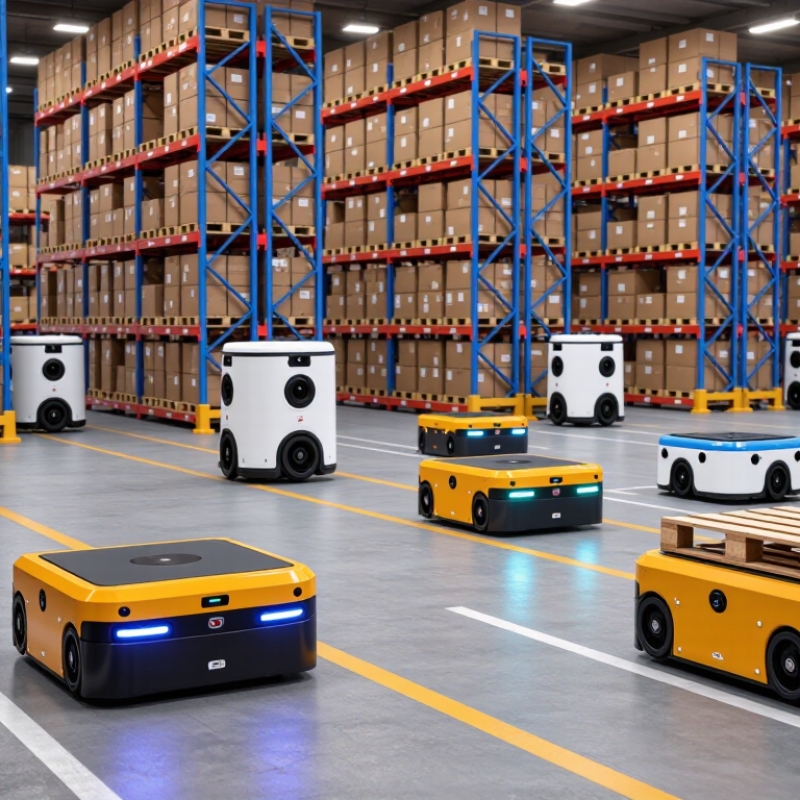
Automated guided vehicles, or AGVs, usually follow defined routes using floor markers, magnetic tape, or reflectors. This makes them suitable for steady, repeatable transport, such as moving pallets between a production line and a warehouse bay. Route changes may require adjustments to the site infrastructure. Autonomous mobile robots, or AMRs, use sensors and onboard maps to plan routes and respond to obstacles. They can adapt more easily to changing work areas, but still need accurate maps and clearly managed pedestrian zones. The boundary can blur.
AGVs often fit predictable, high-volume journeys with limited route variation. AMRs can support order picking, parts delivery, or mixed workflows where people and equipment share space. Neither technology fixes a poorly planned process. A narrow aisle, uneven floor joint, heavy load, or busy doorway can affect performance. It depends.
Global buyers should compare machines against actual site conditions, not only quoted travel speeds. A practical pilot can track completed trips, unexpected stops, charging windows, and operator feedback. Check how vehicles integrate with existing traffic rules and dispatch systems, too. Results may differ between a quiet test area and a crowded shift, so leave room for that uncertainty.
China Top 10 AGV AMR Manufacturers for Global Buyers - AGV and AMR Technologies: Key Differences and Applications
Technology and application comparison for evaluating suppliers. This is not a ranked list of manufacturers; company and brand names are intentionally omitted.
| # | Application or Buyer Requirement | AGV Fit | AMR Fit | Key Evaluation Checks |
|---|---|---|---|---|
| 1 | Fixed-route line-side delivery | Well suited to repetitive routes between set stations, especially where traffic and pickup points are predictable. | Useful when routes or work areas change frequently and vehicles need to navigate around temporary obstacles. | Route changes, station accuracy, traffic controls, integration with production systems. |
| 2 | Pallet transport between fixed points | Often a practical option for high-frequency moves on established paths. | Can suit mixed-traffic areas where paths need to adapt to changing conditions. | Rated payload, pallet pickup method, floor condition, turning space, safety-rated stopping. |
| 3 | Warehouse tote or bin movement | Can work well with stable routes and defined handoff locations. | Commonly considered for flexible point-to-point movement in changing warehouse layouts. | Load interface, location accuracy, fleet coordination, warehouse-management-system integration. |
| 4 | Case or order-picking support | Suitable for repeatable workflows with planned aisles and consistent stopping points. | Can support dynamic workflows and routes that respond to changing task assignments. | Task dispatching, human-robot interaction, aisle width, throughput under peak demand. |
| 5 | Cross-docking and changing material flows | Works where lanes and transfer points are stable and can be clearly defined. | May offer more routing flexibility when load destinations and traffic patterns vary. | Dispatch logic, congestion handling, docking repeatability, compatibility with existing processes. |
| 6 | Cleanroom or controlled-area logistics | Can follow dedicated routes in controlled environments with limited route variation. | Can be considered where flexible routing is needed, subject to environmental and cleanliness requirements. | Cleanroom classification suitability, materials, emissions, cleanability, charging arrangements. |
| 7 | Cold-storage operations | Can suit repeatable routes if the vehicle and navigation equipment are rated for the environment. | Can suit variable routes when sensors, batteries, and electronics are specified for low temperatures. | Operating-temperature range, battery performance, condensation protection, traction and braking. |
| 8 | Heavy or oversized-load movement | May be suitable for planned routes using a vehicle designed for the required load and handling method. | May be suitable when heavy loads must move through changing routes, provided the platform is rated accordingly. | Payload and load center, stopping distance, turning envelope, floor loading, safety validation. |
| 9 | Hospital or facility logistics | Can serve scheduled deliveries along dedicated corridors and fixed transfer points. | Can offer flexibility in shared spaces, subject to safe interaction with people and facility rules. | Elevator and door interfaces, access control, noise, hygiene procedures, pedestrian safety. |
| 10 | Supplier and system-integration readiness | Assess route setup and change procedures, including any required physical or mapped infrastructure. | Assess mapping, localization, obstacle response, and behavior in the facility’s real operating conditions. | Standards compliance, API and fleet integration, service coverage, spare parts, training, acceptance testing. |
Note: AGVs generally operate along predefined or guided routes, while AMRs typically use onboard sensing and navigation to select or adjust routes. Actual capabilities vary by system; some products combine features of both approaches. Verify specifications and safety compliance for the intended site and application.
Related Posts
-

Why is AGV Technology Revolutionizing Material Handling in Warehousing?
-
Which Automated Guided Vehicle System Is Best in 2026?
-
What Is the Best AMR Automated Mobile Robot in 2026?
-
Top 10 Differences Between AGV and AMR Technologies?
-

China Top 10 AGV and AMR Innovations You Need to Know?
-
How to Choose the Right AGV Automation Solution for Your Business Needs