
2026 Top AMR Vehicle Types for Global Buyers?
In 2026, global buyers will assess more than speed when selecting an amr vehicle. They will examine payload, navigation, safety, software, service, and total operating cost. A warehouse moving sealed cartons needs different equipment from a hospital transporting linen or medicines. Context matters.
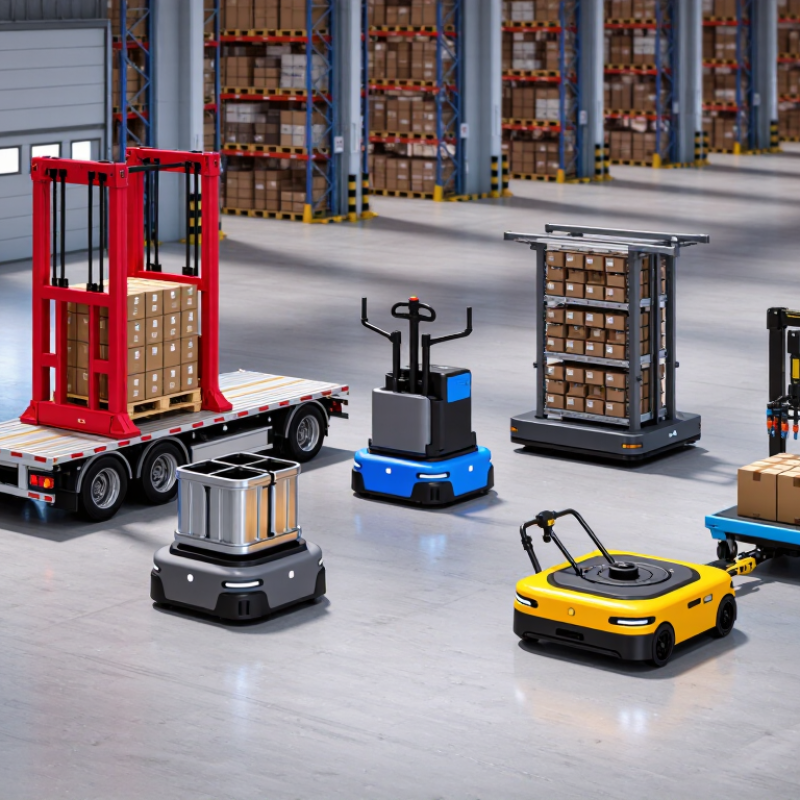
This guide introduces the main AMR categories shaping international purchasing decisions. It considers pallet movers, cart transporters, shelf-carrying robots, tugger units, and flexible hybrid platforms. Each type solves a practical movement problem, but none fits every facility. That limitation deserves attention.
The analysis reflects common deployment experience from warehouses, factories, and healthcare environments. It focuses on measurable details, including aisle width, floor quality, charging patterns, fleet size, and integration with warehouse management systems. Buyers should request documented test results, service terms, cybersecurity information, and references from comparable sites. Marketing claims are useful, but operating evidence is stronger.
A reliable evaluation also considers regional support and operator training. A technically capable vehicle may still underperform when spare parts arrive slowly or workflows remain unclear. Small failures become expensive at scale. Sometimes, a simpler model wins.
The following sections compare vehicle types through practical use cases, technical trade-offs, and purchasing risks. They also question several popular assumptions. Higher autonomy does not always mean better productivity. The lowest purchase price rarely represents the lowest long-term cost. Careful buyers will match vehicle capability with real material flows, not impressive demonstrations.
What Defines an AMR Vehicle in 2026?
In 2026, an AMR vehicle is more than a robot with wheels. It senses its surroundings, creates a local map, and changes routes when people, pallets, or temporary barriers appear. Unlike traditional guided vehicles, it should not depend on fixed magnetic lines or permanent floor markers. Its core value is adaptive movement inside changing facilities.
Professional reports support this shift. The International Federation of Robotics recorded 541,302 industrial robot installations in 2023, showing continued investment in automation. Interact Analysis has also identified logistics mobile robots as a fast-growing segment, driven by labor pressure and flexible warehouse designs. Yet the AMR label remains fuzzy. Some vehicles still need carefully prepared floors, restricted zones, or manual recovery. Full autonomy is not always realistic.
Tips: Check navigation accuracy during peak traffic, not during a quiet demo. Request data on uptime, recovery time, payload stability, and software integration. A useful AMR should connect with warehouse systems, safety controls, and fleet-management tools. It should also explain failures clearly. In my experience, recovery behavior matters more than impressive route planning. The machine will eventually meet a blocked aisle. That moment reveals its real capability. According to the ISO 3691-4 safety framework, risk assessment and protective functions remain essential, even when navigation appears intelligent.
2026 Top AMR Vehicle Types for Global Buyers? — What Defines an AMR Vehicle in 2026?
An autonomous mobile robot (AMR) vehicle is a mobile platform that transports materials or performs a defined mobile task using onboard sensing, software-based route planning and dynamic obstacle avoidance. The specifications below represent common commercial vehicle classes and practical buying considerations for global warehouse, manufacturing and distribution operations.
| AMR Vehicle Type | Primary Function | Typical Payload Range | Load Interface | Typical Operating Environment | Navigation and Mobility | Key Advantages | Important Constraints | Best-Fit Applications in 2026 | Core Buying Metrics |
|---|---|---|---|---|---|---|---|---|---|
| Unit-Load Carrier AMR | Moves bins, totes, cartons or pallets between storage, production and dispatch locations. | Approximately 100–1,500 kg, depending on the vehicle class and deck design. | Powered roller deck, conveyor deck, lift deck or flat platform. | Warehouses, distribution centers, factories and buffer-storage areas with marked loading points. | Laser or camera-based localization, safety scanners, wheel odometry and automatic route planning; usually differential or omnidirectional drive. | Flexible point-to-point transport; can connect multiple workstations without fixed conveyor routes. | Requires standardized load dimensions, suitable floor conditions and clear transfer interfaces. | Inbound staging, line-side delivery, order consolidation, sortation support and finished-goods transfer. | Payload accuracy, deck compatibility, transfer cycle time, fleet availability, turning radius and traffic-management performance. |
| Shelf-to-Person AMR | Brings mobile shelves, racks or storage modules to a picking station so operators do not walk to storage locations. | Approximately 100–1,000 kg, including the transported shelf or rack. | Lift platform, rack-engagement mechanism or under-rack docking system. | High-throughput e-commerce, spare-parts, retail replenishment and small-item fulfillment operations. | Mapped autonomous navigation with obstacle detection, fleet orchestration and precise station docking. | Reduces picker travel, supports high storage density and allows software-controlled slotting changes. | Needs compatible shelving, stable floor flatness, carefully designed pick stations and reliable rack identification. | Piece picking, batch picking, goods-to-person fulfillment and high-SKU inventory operations. | Orders per hour, station utilization, rack capacity, average presentation time, fleet scalability and pick accuracy. |
| Tugger or Towing AMR | Tows one or more carts or trailers through repeated material routes. | Approximately 500–2,500 kg total towed load; the permitted value depends on route, gradient and cart configuration. | Mechanical hitch, automatic coupling or standardized tow bar. | Manufacturing plants, assembly lines, kitting areas, hospitals and large distribution facilities. | Laser, camera or hybrid navigation; typically uses differential drive and follows dynamically planned routes. | Moves several carts in one trip, improves line-feeding efficiency and reduces manual tugger traffic. | Needs turning clearance, controlled trailer geometry, safe coupling areas and careful management of pedestrian crossings. | Milk runs, line-side replenishment, empty-container return, laundry transport and multi-stop internal logistics. | Train capacity, route completion time, hitch reliability, stopping distance, gradient capability and pedestrian-interaction safety. |
| Pallet-Mover AMR | Collects, transports and deposits pallets at floor-level pickup and drop-off locations. | Approximately 600–1,500 kg, with some heavy-duty configurations exceeding this range. | Fork pockets, under-pallet forks or lift forks designed for floor-level pallet access. | Distribution centers, cold-chain facilities, production warehouses and staging zones. | Safety laser scanners, 2D or 3D perception, pallet detection and map-based autonomous driving. | Automates repetitive pallet movements while reducing forklift traffic in selected areas. | Requires consistent pallet quality, defined pickup geometry, adequate aisle width and controlled load overhang. | Receiving-to-storage movement, staging, replenishment, outbound buffering and production-to-warehouse transfer. | Payload stability, pickup success rate, aisle width, pallet tolerance, cycle time, battery endurance and traffic integration. |
| Autonomous Forklift AMR | Lifts and transports palletized loads, including placement at different storage or staging heights. | Approximately 1,000–2,500 kg for common warehouse configurations. | Forks, adjustable forks or specialized load-handling attachments. | Warehouses, manufacturing plants, cross-docks and pallet buffer areas with suitable rack and floor layouts. | Combines safety scanners, 3D cameras, pallet detection, localization and autonomous lift control. | Performs both horizontal transport and vertical load handling, reducing dependence on manual forklift routes. | Higher safety and infrastructure requirements; rack geometry, pallet condition and floor quality are critical. | Put-away, replenishment, pallet retrieval, dock transfer and automated staging. | Lift height, placement accuracy, pallet recognition, load stability, aisle clearance, safety-rated functions and uptime. |
| Cart or Rack-Handling AMR | Moves wheeled carts, roll cages or custom racks between defined work areas. | Approximately 200–1,500 kg, depending on cart size and coupling method. | Under-cart engagement, powered lift, clamp, tow connection or docking interface. | Retail distribution, apparel, parcel handling, manufacturing and healthcare logistics. | Natural-feature navigation, marker-assisted docking, obstacle detection and fleet-level traffic control. | Works with reusable carts and can support many destinations without permanent conveyor installation. | Cart dimensions, wheel condition, docking accuracy and load stability can vary significantly between sites. | Cart staging, store replenishment, parcel movement, work-in-process transfer and linen or supply distribution. | Docking repeatability, cart compatibility, route density, coupling time, throughput and mixed-traffic performance. |
| Picking or Mobile-Manipulation AMR | Combines autonomous mobility with a robotic arm, gripper or other tool to pick, place, scan or handle items. | Mobile base commonly supports approximately 50–500 kg; arm payload is often much lower and application-specific. | Robot arm, gripper, vacuum tool, barcode reader or customized end effector. | Piece-picking areas, kitting cells, laboratory logistics and flexible manufacturing environments. | Mobile mapping combined with vision, force sensing, object recognition and controlled manipulation. | Can perform transport and task execution in one system, reducing handoffs between separate automation cells. | Item variability, grasp reliability, lighting, cycle time and integration complexity can limit performance. | Goods-to-person picking, kitting, machine tending, inspection support and internal sample movement. | Pick success rate, item range, cycle time, gripper compatibility, vision performance and recovery behavior. |
| Special-Purpose Service AMR | Performs a defined mobile service task such as cleaning, inspection, security patrol or internal delivery. | Task-dependent; often approximately 20–500 kg for equipment, supplies or service payloads. | Cleaning brushes, tanks, inspection sensors, shelves, drawers or task-specific equipment. | Factories, warehouses, airports, hospitals, campuses and other large indoor facilities. | Autonomous mapping, lidar or vision sensing, geofencing, scheduled missions and obstacle avoidance. | Extends AMR use beyond material transport and supports repetitive or labor-intensive service activities. | Performance depends heavily on facility access, floor conditions, elevators, doors, public traffic and task-specific sensors. | Floor cleaning, inventory scanning, security rounds, facility inspection and routine internal delivery. | Task completion rate, coverage area, service quality, docking reliability, noise level, battery runtime and human-safety performance. |
Related Posts
-
7 Best AMR Automated Mobile Robots for Global Buyers
-
What Are the Top Mobile Robot Types in 2026?
-
How to Choose the Best AMR Robot for Your Warehouse?
-
Top Mobile Robot Solutions for Global Buyers in 2026?
-
Best Mobile Robots for Efficient Supply Chain Management?
-

Best Mobile Robots in China for Global Buyers?