
Why Choose a Keyless Entry Door Lock for Global Sourcing?
A Keyless Entry Door Lock can turn a plain entrance into a measurable security system. Users may unlock doors with PIN codes, fingerprints, mobile apps, RFID cards, or temporary digital credentials. For global sourcing teams, this flexibility supports hotels, offices, apartments, warehouses, and modern homes across different markets.
Bruce Schneier, a respected security technologist, wrote, “Security is a process, not a product.” This principle matters when evaluating a Keyless Entry Door Lock. A reliable supplier should provide clear specifications, firmware support, access logs, battery warnings, and documented testing. Product samples should be examined in real conditions, including dusty entrances, wet corridors, weak Wi-Fi, and repeated daily use. Small details matter. A stiff keypad can frustrate guests. A hidden emergency power port can prevent a stressful lockout.
Global buyers also need to compare materials, encryption practices, installation methods, warranty terms, and after-sales response. Certifications may differ between regions, so supplier claims require careful verification. A factory visit, sample inspection, and independent quality audit can reveal problems that product photos hide. I would not assume the lowest quotation offers the best value. However, premium pricing alone proves little.
The strongest sourcing decision balances security, durability, usability, integration, and long-term support. Even experienced buyers can overlook battery replacement costs or software compatibility. That is an honest risk. A thoughtful sourcing process reduces it, while helping buyers select a Keyless Entry Door Lock that performs consistently beyond the showroom.
What Is a Keyless Entry Door Lock?
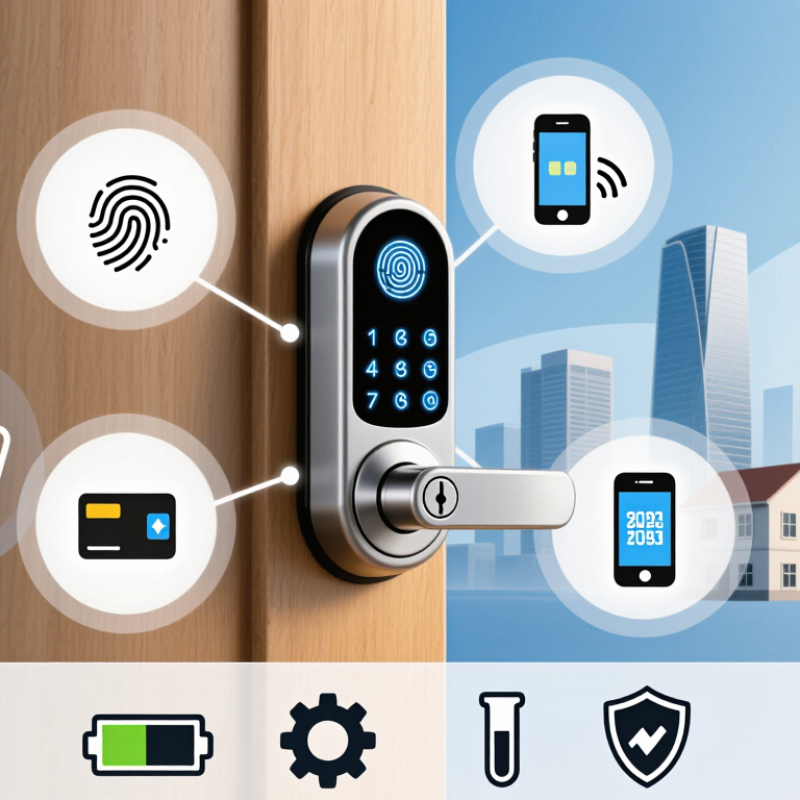
A keyless entry door lock secures a door without a traditional metal key. It uses an electronic or mechanical access method instead. Common options include PIN codes, fingerprint recognition, mobile credentials, cards, and thumb-turn mechanisms. The lock usually contains a latch, an access reader, a control unit, and a power source. When the correct credential is verified, the motor retracts the latch. The door opens smoothly.
In practical product evaluation, the user experience depends on small details. A keypad should remain readable under weak hallway lighting. A fingerprint sensor needs consistent contact, even with slightly damp fingers. Battery access should be simple, but protected from casual tampering. Many electronic models provide low-battery warnings and emergency power contacts. Mechanical backup access may also be included. It is useful, not elegant.
For global sourcing, buyers should define door thickness, backset, latch size, power requirements, and installation direction before requesting quotations. A lock designed for a narrow interior door may fail on a heavy entrance door. Suppliers should provide installation drawings, test records, material details, and operating instructions. Applicable electrical, wireless, fire-safety, and privacy requirements can differ by market, so local verification remains necessary. Claims such as “weatherproof” should be tested against a stated rating, not accepted from a sales sheet alone. Small inconsistencies in drilling templates can create expensive installation delays. Supplier audits, sample testing, and batch inspections improve reliability, although they cannot remove every risk.
| Data Dimension | What It Is or Does | Typical Real-World Data | Global Sourcing Relevance |
|---|---|---|---|
| Definition | A keyless entry door lock is an electronic or electromechanical lock that allows authorized users to unlock a door without inserting a traditional metal key. | Access may be granted by PIN code, fingerprint, RFID card, smartphone, remote control, or a combination of methods. | Suppliers can offer different configurations for residential, office, hospitality, rental, and light-commercial applications. |
| Main Access Methods | The authentication method used to verify an authorized user. |
| Different markets have different preferences, privacy expectations, connectivity habits, and regulatory requirements. A multi-method model can broaden the target market. |
| Power Supply | The energy source that operates the keypad, sensor, motor, and communication module. | Many residential models use four or more replaceable batteries, commonly AA or AAA alkaline cells. Battery life often ranges from several months to about one year, depending on usage and features. | Confirm battery type, battery availability in the destination market, low-battery alerts, standby consumption, and whether batteries are included in the shipment. |
| Emergency Power | A method for opening the lock when the internal batteries are depleted. | Common solutions include an external emergency power contact, a USB power input, a mechanical override cylinder, or a concealed backup keyway. | Emergency access is important for safety and customer acceptance. The backup method should be clearly documented and tested before shipment. |
| Typical Door Compatibility | The door thickness, preparation, backset, handing, and lock body dimensions supported by the product. | Many residential products are designed for common door thicknesses of approximately 35–55 mm, but the actual range varies by model. Common backsets include 60 mm and 70 mm in many markets. | Request installation drawings, latch dimensions, mounting templates, and compatibility details for the destination door market. Do not rely only on product photographs. |
| Security Functions | Features intended to reduce unauthorized entry and improve control over credentials. |
| Security functions should be verified through product testing rather than marketing claims. Ask for access-log capacity, reset procedures, and credential deletion methods. |
| Connectivity | The communication technology used for remote management or integration. | Bluetooth is commonly used for short-range phone access. Wi-Fi enables internet-based remote control but generally requires more power and may require a hub or gateway. Some commercial systems use other wireless protocols. | Connectivity affects certification, software support, data privacy, battery life, app availability, and compatibility with local wireless regulations. |
| Data and Privacy | The way user credentials, access events, and account information are stored and transmitted. | Connected locks may process PINs, device identifiers, access times, and user account information. Local-only models may store credentials inside the lock instead of using cloud services. | For international sales, review data storage location, account recovery, encryption practices, privacy notices, software support, and the ability to delete user data. |
| Weather Resistance | The product’s ability to withstand moisture, dust, and outdoor exposure. | Outdoor suitability is often described using an IP rating, such as IP54 or IP65, but the rating applies to the tested product configuration and does not automatically guarantee protection for every installation condition. | Match the enclosure rating to the installation location. Confirm test reports, operating temperature, corrosion resistance, and installation requirements for exterior doors. |
| Material and Construction | The materials used for the exterior housing, internal mechanism, latch, and mounting components. | Common materials include zinc alloy, stainless steel, aluminum alloy, reinforced plastics, and steel components. Finish options may include painted, plated, brushed, or anodized surfaces. | Material selection affects durability, corrosion performance, weight, appearance, and shipping cost. Samples should be checked for finish consistency and mechanical operation. |
| Relevant Standards | Technical or regulatory requirements that may apply to the lock and its wireless components. | Requirements can include local building and fire codes, electrical safety rules, radio-frequency regulations, battery transport rules, and recognized lock hardware standards such as ANSI/BHMA or EN standards where applicable. | Compliance is market-specific. Determine the destination-country requirements before production and request current test reports issued for the exact model being sourced. |
| Installation Type | The way the lock is fitted to the door. | Common formats include retrofit deadbolt replacements, lever-handle locks, mortise locks, cylindrical locks, rim-mounted locks, and hotel-style electronic locks. | Retrofit designs may reduce installation time, while mortise and commercial formats require closer dimensional matching. Confirm left/right-hand compatibility and adjustment range. |
| User Capacity | The number of fingerprints, PIN codes, cards, or mobile users that the lock can store. | Capacity varies widely by model. Basic products may support a limited number of users, while commercial systems may support substantially more credentials and access records. | Choose capacity based on the application. Ask suppliers to state the exact number of credentials and event records supported for each access method. |
| Operating Temperature | The ambient temperature range in which the lock is designed to function. | Many electronic locks specify a working range around -20°C to 60°C, although the exact range depends on the model, battery type, enclosure, and testing conditions. | Cold climates can reduce battery performance, while high temperatures can affect electronics and adhesives. Verify the rating for the destination climate. |
| Quality Inspection Points | Checks used to confirm that the product meets technical and appearance requirements before shipment. |
| A documented inspection plan reduces inconsistent batches, installation complaints, returns, and failures caused by unsuitable door dimensions. |
| Why Choose Keyless Entry for Global Sourcing? | Keyless locks can provide convenient access management without requiring users to carry or duplicate traditional keys. | Potential advantages include temporary access codes, easier credential revocation, access records on selected models, reduced key-management needs, and flexible product positioning across multiple channels. | Global buyers should balance convenience with cybersecurity, regulatory compliance, after-sales support, replacement parts, software availability, battery logistics, and destination-market compatibility. |