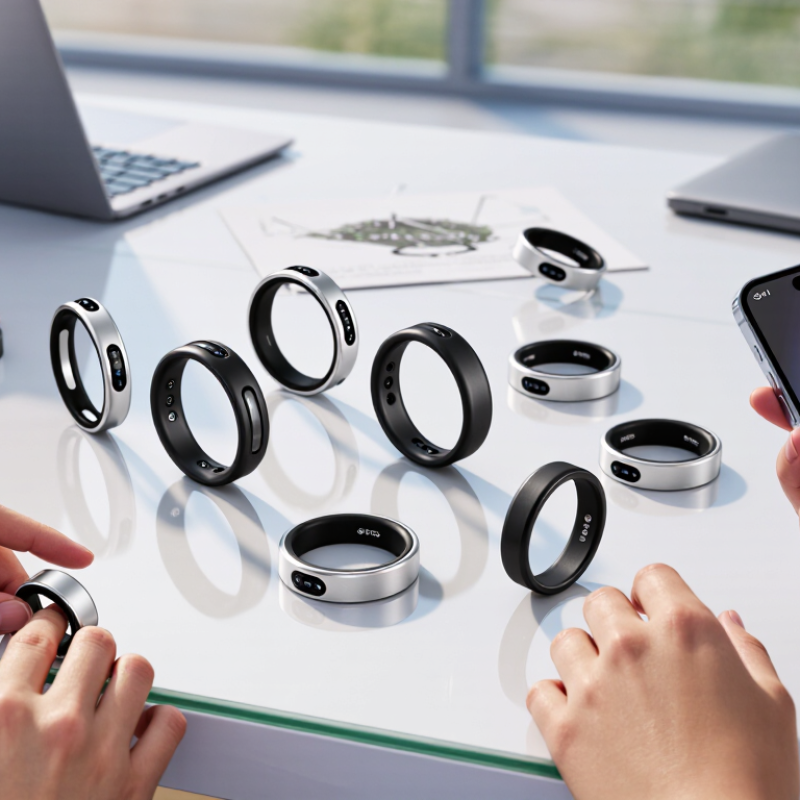
China Best Stress Monitoring Ring for Global Buyers?
China’s Stress Monitoring Ring market has become a practical option for global buyers. Manufacturers now offer compact sensors, mobile apps, and flexible export services. Yet low prices alone do not prove product quality.
Dr. Shyamal Patel, Oura’s Chief Medical Officer, has said, “Wearable technology can help people understand their health in a more continuous way.” This perspective matters when evaluating Chinese suppliers. A credible ring should measure useful signals, such as heart rate variability, resting heart rate, skin temperature, and sleep patterns. These signals may indicate stress responses. They do not diagnose anxiety, depression, or medical conditions.
Look closely at the details. Ask how the company validates its sensors. Request battery tests, app screenshots, language options, and sample reports. Check whether the ring fits comfortably during meetings, exercise, and sleep. A polished product photograph proves very little. Independent testing is better. Clear data policies matter too, especially for international customers.
The best choice may not be the cheapest model. It should balance sensor performance, comfort, software stability, privacy protection, warranty support, and delivery reliability. Some suppliers communicate well before payment, then respond slowly after shipping. That risk deserves attention.
A buyer should also question the word “accurate.” Accuracy depends on skin contact, movement, finger placement, and algorithm quality. No wearable performs perfectly. I have seen product comparisons become too focused on specifications. Real daily usability can matter more.
This guide examines Chinese Stress Monitoring Ring suppliers through evidence, user experience, technical capability, and after-sales reliability. The goal is not to praise every manufacturer. It is to help global buyers make a careful, informed decision.
What Is a Stress Monitoring Ring and How Does It Work?
A stress monitoring ring is a small wearable device that estimates changes in your body’s stress response.
It usually combines optical sensors, skin temperature tracking, movement data, and heart rate measurements. Some models also analyze heart rate variability, or HRV, during rest and sleep.
The ring does not directly measure emotions. Instead, its software compares several signals with your normal patterns.
A sudden heart rate increase, poor sleep, and reduced HRV may suggest physical strain. Results can change after exercise, caffeine, illness, or a loose fit. No ring reads stress perfectly.
That matters for global buyers comparing products from China. Sensor accuracy, app stability, data protection, and testing documentation deserve careful review. In my experience, comfortable materials and reliable charging often matter as much as advanced algorithms.
Tips: Choose a ring with clear data explanations, adjustable sizing, and export options. Check whether measurements are described as wellness insights, not medical diagnoses. Ask suppliers about calibration, battery testing, skin-contact materials, and software updates. A sample order can reveal issues that product photos hide. Also, test the ring during normal work, quiet sleep, and light exercise. One limitation remains easy to overlook: stress scores may feel precise, but they are still estimates.
Key Features Global Buyers Should Evaluate
China Best Stress Monitoring Ring for Global Buyers?
Global buyers should evaluate evidence before appearance. The Global Wellness Institute valued the wellness economy at $5.6 trillion in 2022, showing strong demand for personal health tools. However, stress tracking remains an estimate, not a medical diagnosis. A suitable ring should combine heart rate, heart-rate variability, skin temperature, motion, and sleep data. Each sensor should have clear measurement limits. Look for published validation studies, not only laboratory claims. Fit matters too. A loose ring can distort readings during sleep or exercise. Battery life of five days or longer reduces missing data. Water resistance and skin comfort also support daily use.
Privacy needs equal attention. The ring should offer encrypted transfer, transparent data retention, account deletion, and regional privacy compliance. Buyers should check whether data stays in the user’s country or moves through overseas servers. Exportable records help hospitals, researchers, and corporate wellness teams review trends independently. The 2023 IDC Worldwide Quarterly Wearable Device Tracker recorded 520.5 million wearable shipments globally, but high adoption does not prove accuracy. That distinction is easy to miss.
Tips: Compare sensor specifications, validation methods, warranty terms, and app languages. Test several sizes during sleep. Ask for raw-data access. Treat sudden stress scores as prompts for reflection, not clinical conclusions. A ring may detect a pattern, yet the pattern may reflect caffeine, heat, or poor fitting. That uncertainty deserves honest attention.
This illustrative 1–5 evaluation framework highlights the factors global buyers should compare when selecting a stress-monitoring ring. Higher scores indicate greater importance for reliable long-term stress and recovery tracking, especially through HRV trends, sleep quality, resting heart rate, temperature changes, data transparency, and all-day comfort.
Leading Chinese Stress Monitoring Ring Options
Chinese stress monitoring ring manufacturers now offer practical options for global buyers seeking compact wellness devices. In product evaluations, the strongest models combine heart-rate variability, resting heart rate, skin temperature, sleep, and activity data. These signals can show patterns linked with stress, but they cannot diagnose anxiety or medical conditions. A comfortable inner surface matters. If the ring feels tight during sleep, users may remove it and create incomplete records.
Many Chinese suppliers support OEM or ODM projects, allowing buyers to request different sizes, charging cases, app languages, and dashboard designs. Reliable suppliers should explain sensor specifications, battery performance, testing methods, and data-handling procedures clearly. Ask for sample units before placing a large order. Check readings during a calm morning, after exercise, and before sleep. Results may vary. That is normal, but unexplained gaps deserve attention.
Tips: Compare at least three samples. Confirm app compatibility with Android and iOS devices. Request evidence of quality testing and product safety compliance for your target market. Review the privacy policy in plain language, especially cloud storage and user permissions. Do not judge accuracy from one night of data. I once treated an irregular reading as a serious trend, but the ring had shifted while sleeping. Position matters. Calibration and user education remain easy to overlook.
How to Compare Accuracy, Comfort, and Battery Life
China Best Stress Monitoring Ring for Global Buyers?
Accuracy should be judged beyond a single percentage. A 2023 review in Sensors found wearable stress-classification results ranging from about 60% to above 90%, depending on datasets and testing methods. That spread matters. Ask for sensitivity, specificity, and F1-score, not only “accuracy.” A ring should combine heart-rate variability, skin temperature, movement, and sleep signals. Stress is inferred, not directly measured. Cold fingers, loose sizing, and intense exercise can distort readings.
Comfort decides whether the data is useful. A ring that feels tight after six hours may be abandoned before bedtime. Check weight, inner edges, charging contact, and sizing changes during heat or sleep. ISO 10993-5 and ISO 10993-10 are useful references for evaluating skin-contact materials, although they do not guarantee comfort for every user. In practical trials, wear the ring continuously for at least seven days. That exposes irritation and missed readings.
Battery claims need careful testing. Compare real-world runtime with continuous monitoring enabled, not standby time. Independent wearable reviews commonly show battery life falling when sensors sample frequently or temperatures change. A useful purchasing test is simple: record runtime during sleep tracking, exercise, and daily notifications. Results may vary. That weakness deserves attention. Also check charging time, data export, and whether readings remain available offline. A transparent technical report is more reliable than polished marketing language.
Ordering, Compliance, and After-Sales Support for Global Buyers
China Best Stress Monitoring Ring for Global Buyers?
Ordering a stress monitoring ring requires more than comparing unit prices. Ask for a working sample, full specifications, and a clear minimum order quantity. Confirm sensor accuracy, battery life, charging method, app languages, and data export options. A small pilot order can reveal sizing problems before large production begins. That step is easy to skip.
Compliance needs written evidence. Request test reports for radio functions, battery safety, materials, and electromagnetic compatibility. Requirements vary by destination, so local regulatory review remains essential. The ring should not be presented as a medical diagnostic device without proper authorization. Stress scores are often estimates from heart rate, temperature, sleep, and movement data. They need careful explanation. Privacy also matters. Confirm where data is stored, how it is encrypted, and whether users can delete it. Some suppliers answer vaguely here. Treat that as a warning.
After-sales support can decide whether a shipment becomes a long-term business. Agree on warranty length, defect handling, replacement rules, and response times before payment. Ask who handles firmware updates and app compatibility. A named technical contact is useful across time zones. Keep photos, serial records, and inspection reports for every batch. Problems happen. The real test is how quickly and honestly they are handled. One practical weakness remains: some suppliers promise customization before confirming tooling costs. Put every promise in the purchase agreement.
China Best Stress Monitoring Ring for Global Buyers? - Ordering, Compliance, and After-Sales Support for Global Buyers
| Evaluation Area | Typical Market Information | Evidence to Request | Global Buyer Considerations |
|---|---|---|---|
| Product Positioning | Consumer wellness wearable unless it has documented medical-device authorization for specific intended uses. | Intended-use statement, product specification sheet, risk classification, and user manual. | Do not use medical, diagnostic, or treatment claims in marketing unless the product is authorized for those claims in the target market. |
| Stress-Related Metrics | Common inputs include heart rate, heart-rate variability, resting heart rate, sleep duration, movement, and temperature trends. | Sensor list, measurement method, sampling limitations, algorithm description, and validation summary. | Stress scores are estimates and may be affected by motion, skin contact, temperature, exercise, alcohol, medication, and individual physiology. |
| Ring Sizing | Sizing systems vary by supplier and may not match local or international ring-size standards. | Official size chart, sizing samples, inner-diameter measurements, and sample-fitting procedure. | Confirm whether the supplier provides a sizing kit and define responsibility for incorrect size selection before ordering. |
| Minimum Order Quantity | MOQ varies by configuration, packaging, logo, software customization, and private-label requirements. | Written quotation showing MOQ for standard units, custom packaging, firmware, app, and logo printing. | Request separate pricing for samples, pilot quantities, and full production to reduce initial inventory risk. |
| Sample and Pilot Order | A pilot order should test sizing, charging, app pairing, data synchronization, packaging, and return handling. | Sample invoice, functional test checklist, sample report, and acceptance criteria. | Approve mass production only after written confirmation that pilot issues have been resolved. |
| Production Lead Time | Lead time depends on stock availability, component supply, quantity, customization, quality inspection, and holiday schedules. | Production schedule with order confirmation date, inspection date, dispatch date, and delay-notification procedure. | Treat quoted lead time as a planning estimate unless delay remedies are included in the purchase agreement. |
| Battery and Charging | Battery runtime depends on sensor use, Bluetooth activity, temperature, firmware, and charging frequency. | Battery capacity, charging specifications, cycle-life information, temperature limits, and transport documentation where applicable. | Confirm spare charger availability, charging safety instructions, and lithium-battery shipping requirements. |
| Water Resistance | Water-resistance claims should identify the tested protection level and conditions; water resistance can decline after impact or repair. | Ingress-protection test report, test standard, test conditions, and user restrictions. | Clarify whether swimming, diving, hot water, soap, and seawater are excluded from the warranty. |
| Wireless Connectivity | Bluetooth Low Energy is commonly used for communication with a mobile application; compatibility depends on operating-system support. | Supported Bluetooth profile, phone compatibility list, operating-system requirements, and pairing instructions. | Test the application in each target country and confirm language, notification, account, and regional-service availability. |
| Radio Compliance | Wireless products may require market-specific radio compliance, such as CE requirements in the European Economic Area and FCC requirements in the United States. | Applicable declaration of conformity, test reports, technical file references, and labeling artwork. | Check the rules for every destination market; one regional approval does not automatically cover all countries. |
| Chemical and Environmental Compliance | Depending on the destination, requirements may include restrictions on hazardous substances, chemicals, batteries, packaging, and electronic waste. | Material declarations, supplier declarations, laboratory reports, battery information, and recycling-label requirements. | Confirm importer or producer responsibilities for product registration, recycling, and packaging obligations. |
| Personal Data and Privacy | Health-related and biometric information may require heightened privacy controls, depending on the data and jurisdiction. | Privacy policy, data-processing terms, retention policy, deletion process, subprocessor list, and security overview. | Define data ownership, international transfers, user consent, breach notification, and account-deletion procedures before launch. |
| Quality Control | Quality checks commonly cover appearance, dimensions, charging, connectivity, sensor operation, packaging, and software functions. | Inspection checklist, defect classification, sampling plan, batch records, and pre-shipment inspection report. | Agree on acceptable quality limits and corrective-action timelines in the purchase contract. |
| Packaging and Labeling | Labels may need model identification, electrical ratings, regulatory marks, importer details, warnings, and disposal information. | Packaging artwork, label files, carton dimensions, barcode format, language versions, and labeling approval record. | Review local-language instructions and ensure the responsible economic operator is correctly identified where required. |
| Shipping and Trade Terms | Shipping cost and responsibility depend on the agreed Incoterm, destination, cargo type, insurance, and customs treatment. | Commercial invoice, packing list, transport document, battery declaration if applicable, HS-code proposal, and country of origin. | Specify who pays duties, taxes, customs fees, inspection charges, and last-mile delivery costs. |
| Warranty | Warranty duration and coverage vary; exclusions often include misuse, unauthorized repair, accidental damage, and normal battery degradation. | Written warranty policy, start date, covered parts, return procedure, shipping responsibility, and remedy options. | Ensure the warranty is enforceable for the buyer’s jurisdiction and covers both hardware and required software support. |
| After-Sales Response | Effective support should provide a ticket channel, troubleshooting guides, firmware updates, replacement procedures, and escalation contacts. | Service-level targets, support hours, response-time commitment, spare-parts list, and repair or replacement workflow. | Ask whether support is available in the buyer’s language and time zone, and whether remote diagnostics require user data access. |
| Software and Firmware Updates | Updates may improve compatibility, security, battery performance, or measurement algorithms, but can also change functions. | Update policy, support period, release notes, rollback policy, and security-vulnerability reporting process. | Define the minimum software-support period required for the intended sales channel. |
| Payment and Contract Protection | Commercial terms may include a deposit, balance before shipment, inspection holdback, or payment through a protected platform. | Pro forma invoice, purchase agreement, inspection clause, refund terms, intellectual-property terms, and dispute-resolution clause. | Use milestone payments tied to sample approval, production completion, inspection, and shipping-document release. |
| Buyer Qualification Checklist | A suitable supplier should provide consistent technical documents, transparent commercial terms, traceable quality records, and responsive support. | Completed compliance file, validated samples, factory or quality audit results, reference procedures, and signed specification sheet. | Compare suppliers on total landed cost, compliance readiness, data protection, update support, warranty execution, and delivery reliability—not price alone. |
Note: Compliance obligations depend on the product configuration, claims, destination country, sales channel, and importer responsibilities. Buyers should obtain current, product-specific documentation and confirm requirements with qualified regulatory or customs professionals before commercial launch.