| 1 | Supplier Reliability | Check the supplier’s registered business details, export experience, production capacity, inspection process, and references from comparable industrial buyers. | A reliable supplier should provide a consistent company profile, traceable product documentation, responsive communication, and a clear complaint-handling process. | Unverifiable address, changing product specifications, copied certificates, vague production information, or refusal to provide samples. | Request a pre-production sample, factory or video audit, recent inspection records, and two independent trade references before placing a large order. |
| 2 | Material and Construction | Confirm whether the box is made from powder-coated steel, stainless steel, aluminum, or impact-resistant polymer, and verify wall thickness, hinge strength, lock points, and corrosion resistance. | Material selection should match the environment: stainless steel for corrosive areas, coated steel for general industrial use, and polymer for lightweight or electrically sensitive applications. | No material grade, no dimensional drawing, sharp edges, weak hinges, poor coating adhesion, or unclear load capacity. | Obtain a technical drawing, material declaration, surface-treatment details, and photos of hinges, hasps, mounting points, and internal compartments. |
| 3 | Certifications and Compliance | Verify the scope, issuing body, certificate number, validity period, and model coverage of quality-management or product-related documents. Check market-specific requirements for electrical or hazardous locations. | ISO 9001 may demonstrate a quality-management system, but it does not automatically certify the lockout box itself. Product compliance must match the destination market and application. | Expired documents, certificates issued for another product, unverifiable test reports, or claims of universal compliance without standard references. | Ask for original PDF documents, laboratory test reports, declarations of conformity where applicable, and written confirmation of the standards used. |
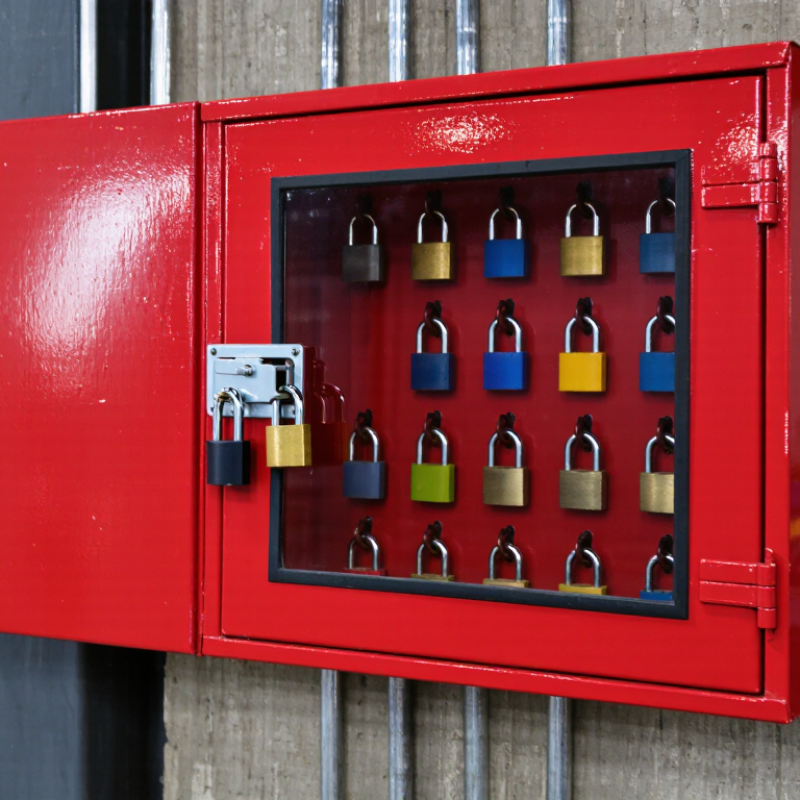
| 4 | Functional Design and Capacity | Evaluate the number of padlock positions, internal storage volume, visibility, wall-mounting options, label areas, drainage, and compatibility with group lockout procedures. | The selected capacity should cover the maximum number of authorized workers and required keys, with enough clearance for gloves and commonly used padlocks. | Padlock holes that are too small, inaccessible key storage, insufficient mounting strength, confusing labels, or a design that cannot support group procedures. | Create a capacity checklist based on actual users, padlock dimensions, key quantities, mounting location, and required safety labels. |
| 5 | Pricing and Total Cost | Compare unit price, tooling, customization, packaging, inspection, taxes, freight, payment fees, spare parts, and after-sales support rather than comparing only the quoted product price. | For standard industrial boxes, small-order pricing is typically higher than volume pricing; custom materials, printing, compartments, and special coatings increase the total cost. | Unusually low pricing, hidden mold charges, unclear Incoterms, unexplained surcharges, or a quotation without specifications and packaging details. | Use a total-cost comparison sheet and request comparable quotations based on identical material, dimensions, quantity, packaging, delivery term, and inspection scope. |
| 6 | Production and Delivery Lead Time | Confirm sample time, production time, inspection time, dispatch date, transport mode, export documents, and the supplier’s ability to handle repeat orders. | Standard items may be available from stock or require several weeks; customized products commonly require additional time for tooling, approval, production, and inspection. | Only verbal delivery promises, no production schedule, no shipment tracking, or inability to explain delays and corrective actions. | Include milestone dates, approved-sample requirements, inspection points, late-delivery remedies, and document responsibilities in the purchase contract. |
| 7 | Delivery, Packaging, and After-Sales Support | Review packaging strength, pallet or carton standards, spare-part availability, replacement policy, warranty terms, technical support, and communication during transport. | Packaging should prevent scratches, deformation, moisture damage, and missing accessories. Support should include clear response times and a documented claims process. | No packaging specification, missing accessories, unclear warranty exclusions, slow responses, or refusal to replace damaged or incorrect goods. | Approve packaging samples, define an incoming-inspection procedure, photograph damaged cartons, and retain serial, batch, and shipping records for claims. |